A tectonic boundary where two plates are moving toward each other. Convergent boundaries are the borders between the plates that are moving towards each other and colliding.
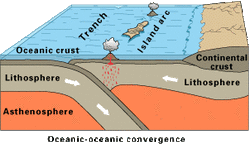
Convergent plate boundaries are locations where lithospheric plates are moving towards one another.
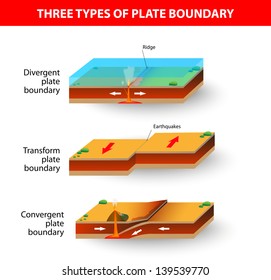
What is a convergent boundary. A convergent boundary is an area on Earth where two or more lithospheric plates collide. Convergent boundaries form strong earthquakes as well as volcanic mountains or islands when the sinking oceanic plate melts. What Happens At A Convergent Boundary.
One plate eventually slides beneath the other a process known as subduction. If the two plates are of equal density they usually push up against each other forming a mountain chain. A convergent boundary also known as a destructive boundary is an area on Earth where two or more lithospheric plates collide.
If the two plates are of equal density they usually push up against each other to form a mountain chain. When this happens one plate usually subducts beneath the other plate and in the case of. A continental-continental plate boundary.
A convergent plate boundary is a location where two tectonic plates are moving toward each other often causing one plate to slide below the other in a process known as subduction. Tectonic plates are in constant although extremely slow movement. Plates can diverge or slide past one another.
The plate collisions that occur in these areas can produce earthquakes volcanic activity and crustal deformation. If they are of unequal density one plate usually sinks subducts beneath the other. Convergent plate boundaries are where plates collide.
Convergent boundaries also referred to as destructive plate boundaries are locations on the lithosphere where two or more tectonic plates move towards each other leading to high levels of tectonic activities. The collision of tectonic plates can result in earthquakes volcanoes the formation of mountains and other geological events. Kən-vur jənt A tectonic boundary where two plates are moving toward each other.
As shown below the plates are made of rigid lithosphere consisting of the Earths. When a continental plate and an ocean plate converge the ocean plate is heavier and subducts beneath the continental plate. When plates collide many geologic activities occur and landforms are created depending on the types of crust that are converging.
When oceanic crust collides with less dense tectonic plates they become subducted causing dangerous earthquakes and volcanoes. Additionally which types of boundaries produce subduction. A convergent plate boundary is the boundary that occur when two plates collide each other either a continental plate with continental plate or oceanic plate.
The subduction zone can be defined by a plane where many earthquakes occur called the Benioff Zone. One plate eventually slides beneath the other causing a process known as subduction. If they are of unequal density one plate usually sinks beneath the other in a subduction zone.
They are formed when two plates collide either crumpling up and forming mountains or pushing one of the plates under the other and back into the mantle to melt. One type of tectonic plate boundary -- a boundary separates the large plates composing Earths surface -- is the convergent boundary. It occurs when the Indian plate was collided with the Eurasian plate.
Where they collide they form tumultuous convergent boundaries where one plate is either destroyed hence the alternate term destructive plate boundaries or jams up against the other. The subduction zone can be defined by a plane where many earthquakes occur called the WadatiBenioff zone. Convergent boundaries are highly unstable areas of the lithosphere of the Earth.
The plates form a subduction zone with one plate descending beneath the other plate. There are three examples of convergent plate boundaries that occur as the result of continental and oceanic plate convergence. Their movements cause land to separate islands to form mountains to rise water to cover land and earthquakes to occur.
The Himalayas were formed by such a collision. This causes very large earth movements. As the plates converge the denser thinner tectonic plate subducts or dives beneath the lighter thicker more buoyant tectonic plate.
A convergent plate boundary occurs when a collision of tectonic plates causes one plate to slide over the top of another. Two ocean plates converge forming a subduction zone also. Convergent boundaries occur where the Earths tectonic plates collide or move toward one another.
Convergent boundaries form when two crustal plates are colliding. Convergent boundary definition a major geologic discontinuity or suture marking the juncture of lithospheric plates that have been joined by plate tectonics. Facts about Convergent Boundaries 10.
Plate collision can produce earthquake volcanoes mountains formation and other geological event. The formation of the Himalayan and Tibetan Plateau is a result of a continental-continental plate boundary. Also called collision zone.
Convergent boundary types include oceanicoceanic oceaniccontinental and continentalcontinental.