Not negative - so its positive - - positive and a positive plus and a plus. Now lets look at the reverse equation.
 Understanding The Rules Of Positive Negative Signs Numbers Youtube
If it is negative- change to positive.

Negative and positive rules. SAME SIGN- Add absolute values and keep sign. Examples are the sentences Jane is here. If I say Eat I am encouraging you to eat positive If I say Do not eat I am saying the opposite negative.
When a number has no sign it usually means that it is positive. Answer will be positive. Negative and a positive minus and a plus.
Is the positive sign is the negative sign. The rule works the same way when you have more than two numbers to multiply or divide. In linguistics and grammar affirmation and negation abbreviated respectively AFF and NEG are the ways that grammar encodes negative and positive polarity in verb phrases clauses or other utterancesEssentially an affirmative positive form is used to express the validity or truth of a basic assertion while a negative form expresses its falsity.
The discovery of infrequent itemsets is far more difficult than their counterparts. When you multiply a negative number by a positive number or vice versa the product will be negative. Adding negative numbers to positive numberscount backwards as if you were subtracting.
The rules of how to work with positive and negative numbers are important because youll encounter them in daily life such as in balancing a bank account calculating weight or preparing recipes. To get a negative number you need one negative and one positive number. Two signs that are different become a.
When you are adding a negative number to a positive number you are effectively subtracting the second number from the first. For example take 4 -2. So 3 is really 3.
4 -4 Keep change change 4 4 NOW USE THE RULES FOR ADDING. Often brackets are put around negative numbers to make them easier to read eg. A positive number divided by a positive is always positive and a negative divided by a positive or vice-versa is always negative.
5 is really 5 And we can put around the numbers to avoid confusion. An even number of negative numbers will give a positive answer. Subtracting positive and negative numbers can also be tricky because there are several rules to remember and follow.
An odd number of negative numbers will give a negative answer. When dividing a negative by a negative you divide the absolute values by each other. Adding and multiplying combinations of positive and negative numbers can cause confusion and so care must be taken.
You cannot divide by zero. Note that positive numbers are the most commonly used and so the positive sign is usually omitted so that 3 is usually written instead of3. Subtracting Positive and Negative Numbers.
Two negatives make a positive so a negative number times a negative number makes a positive number. Dont let all this talk of positive and negative numbers throw you off trackif you see a positive number minus a positive number. If a number is positive the is usually missed out before the number.
In division rules vary slightly from multiplication. However in recent years there has been a significant research focused on finding interesting infrequent itemsets leading to the discovery of negative association rules NARs. Positive integers have values greater than zero.
Multiplying different signs will always give you a negative product and multiplying the same signs will give you a positive product. Now if I say Do NOT not eat I am saying I dont want you to starve so I am back to saying Eat positive. If you multiply two negative numbers or two positive numbers the result will be positive.
Subtracting a positive number from a positive numberthis is normal subtraction. 4 4 8 MULTPLYING INTEGERS SAME SIGNS- POSITIVE Multiply the numbers. When the signs are the same the answer is positive.
Association rule mining research typically focuses on positive association rules PARs generated from frequently occurring itemsets. Positive- change to negative. A negative number times a negative number equals a positive number.
Rules for adding and subtracting positive and negative numbers When two signs are written next to each other the rules for adding and subtracting numbers are. When the signs are different the answer is negative. Positively a negative - - - - negative and a negative minus and a minus.
Positively positive. The rule for multiplying and dividing is very similar to the rule for adding and subtracting. Positive three may be written as3 and negative three may be written as3 to distinguish the signs from the operations add and subtract.
If you look at it on the number line walking backwards while facing in the negative direction you move in the positive direction. Negative integers have values less than zero. Zero is neither positive nor negative.
The differences between Gram positive and Gram negative bacteria are primarily related to their cell wall composition. Difference between Gram-positive and Gram-negative.
If so then you can understand the natural health implications of Gram-positive bacteria.
Difference between gram positive and gram negative bacteria. Basic counter stain known as safranin is applied on the slide which affects the gram-negative bacteria that appeared as red or pink. Gram-negative bacteria are characterized by cell wall components called lipopolysaccharide LPS which are. Gram-positive bacteria saw violet and gram-negative bacteria are colorless under a microscope.
The key to understanding these differences is in the protective membrane or outer covering surrounding these bacterial organisms. Both gram negative and gram positive bacteria have covalently closed circular DNA as the genetic material. Differentiate between gram positive and negative bacteria.
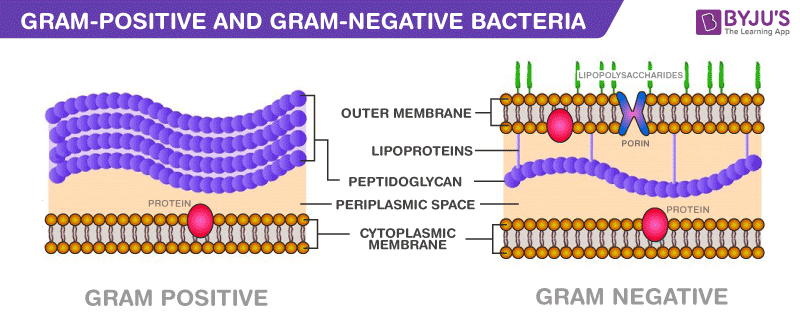
When the negative gram bacteria is stained with safranin or fuchsin in the experiment it gives red or pink color. The diagram below illustrates the differences in the structure of Gram positive and Gram negative bacteria. Difference between Gram-Positive and Gram-Negative Bacteria Key Points The cell wall of gram-positive bacteria is composed of thick layers peptidoglycan.
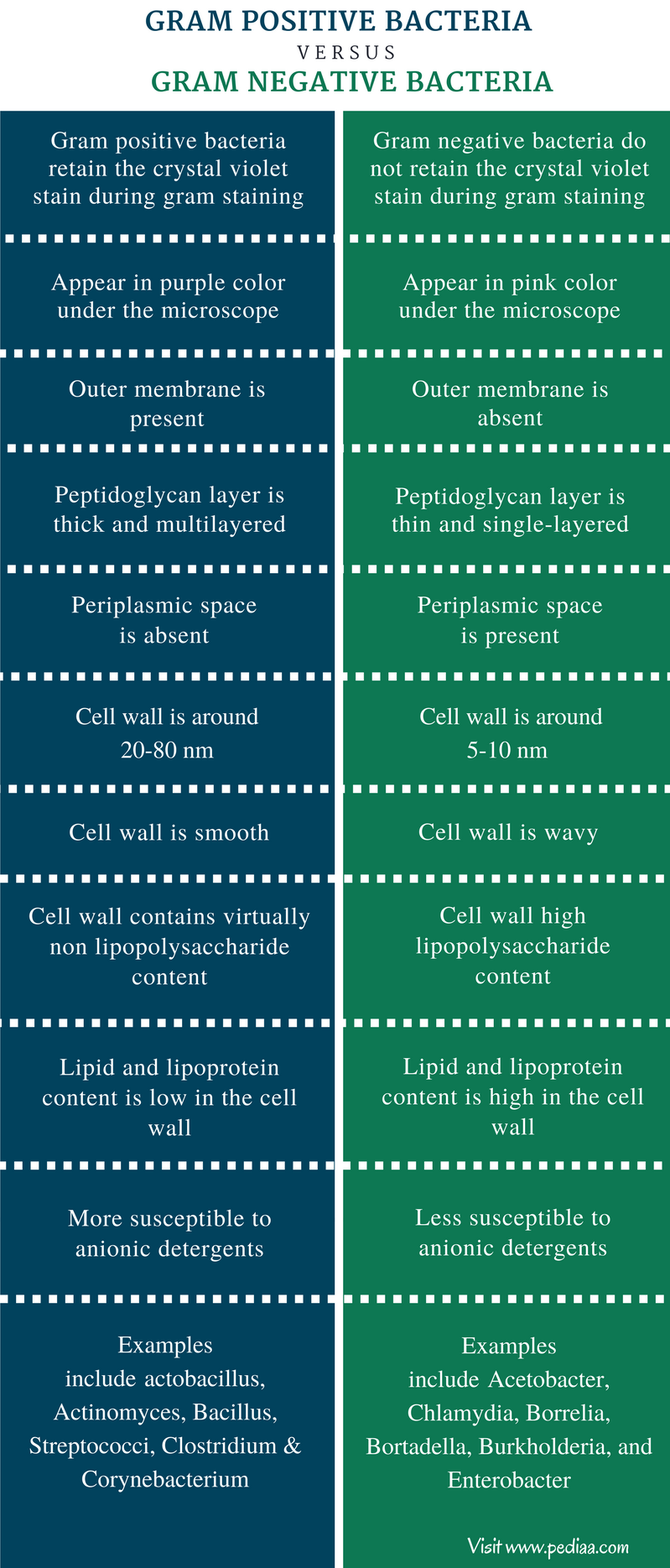
Gram-negative bacteria more pathogenic rather than bacteria gram-positive bacteria 11. Gram negative bacteria contain an extra layer of cells called outer membrane or LPS layer which surrounds the thin peptidoglycan layer. The two key features that lead to the differing visualization properties of Gram positive and Gram negative species are the thickness of the peptidoglycan layer and presence or absence of the outer lipid membrane.
Difference Gram-Positive Bacteria. The difference is clear but in simple explanation gram staining is what makes bacteria to be gram positive or negative and this happens because gram positive bacteria have thick peptidoglycan which retains crystal violet staining dye as opposed to gram. Cell wall of gram-positive bacteria contains less of lipids 2-4.
This is due to the difference in the structure of their bacterial cell wall. Both are prokaryotic in nature. The upcoming discussion will update you about the difference between Gram-Positive and Gram-Negative Bacteria.
The main difference between gram positive and gram negative bacteria is that gram positive bacteria contain a thick peptidoglycan cell wall along with teichoic acid allowing the bacteria to stain in purple during gram staining whereas gram negative bacteria contain a thin peptidoglycan cell wall with no teichoic acid allowing the cell wall to stain in pink during counter staining. Absent or lower content of lipids than Gram Negative bacteria. 28 Differences Between Bacteria and Virus Bacteria vs Virus.
Gram-negative bacteria have a thin membrane which is nearly bulletproof. There are structural differences between Gram positive and Gram negative bacteria that makes them appear different after Gram staining experiment. The outer membrane is absent in gram-positive bacteria.
The cell wall of gram-negative bacteria is composed of thin layers of peptidoglycan. The major difference between gram positive and gram negative bacteria is that gram positive bacteria have a thick peptidoglycan layer in their cell wall while gram negative bacteria have a thin peptidoglycan layer in their cell wall. Both gram positive and gram negative bacteria undergo binary fission as a mode of asexual reproduction.
On adding a counterstain such as safranin or fuchsine after washing Gram-negative bacteria are stained red or pink while Gram-positive bacteria retain their crystal violet dye. Cell wall thick 150-200 A thick straight single layered and outer membrane is absent in gram-positive bacteria. The cell wall of the former kind is thicker peptidoglycan wall whereas that of latter is thinner.
2 rings in basal body. The cell wall of the gram-positive bacteria is thicker as compared to the cell wall of the gram-negative The cell wall of gram positive bacteria is smooth whereas the cell wall of gram-negative bacteria is wavy. Contains higher content of lipids than Gram positive bacteria due to presence of outer membrane 9.
In the gram staining procedure gram-positive cells retain the purple coloured stain. This step is known as a differential step. The gram-positive bacteria produce exotoxins while the periplasmic space either absent and if present then it is very narrow and the gram-negative bacteria produce endotoxins the periplasmic space present in them.
Gram negative and gram positive bacteria both lack membrane bound organelles. Gram-positive bacteria- cell wall examples diseases antibiotics. Gram-negative bacteria- cell wall examples diseases antibiotics.
4 rings in basal body. These bacteria stain purple after Gram staining. Difference between Gram positive and Gram Negative bacterial cell wall The cell wall of Gram negative bacteria is more complex than those of Gram positive bacteria.
Apart from the peptidoglycan layer gram negative bacteria possess an outer membrane and it is absent in gram. Gram positive bacteria have cell walls composed mostly of a substance unique to bacteria known as peptidoglycan or murein.