First lets calculate the amount of both reactants. The limiting reagent or reactant in a reaction is found by calculating the amount of product produced by each reactant.
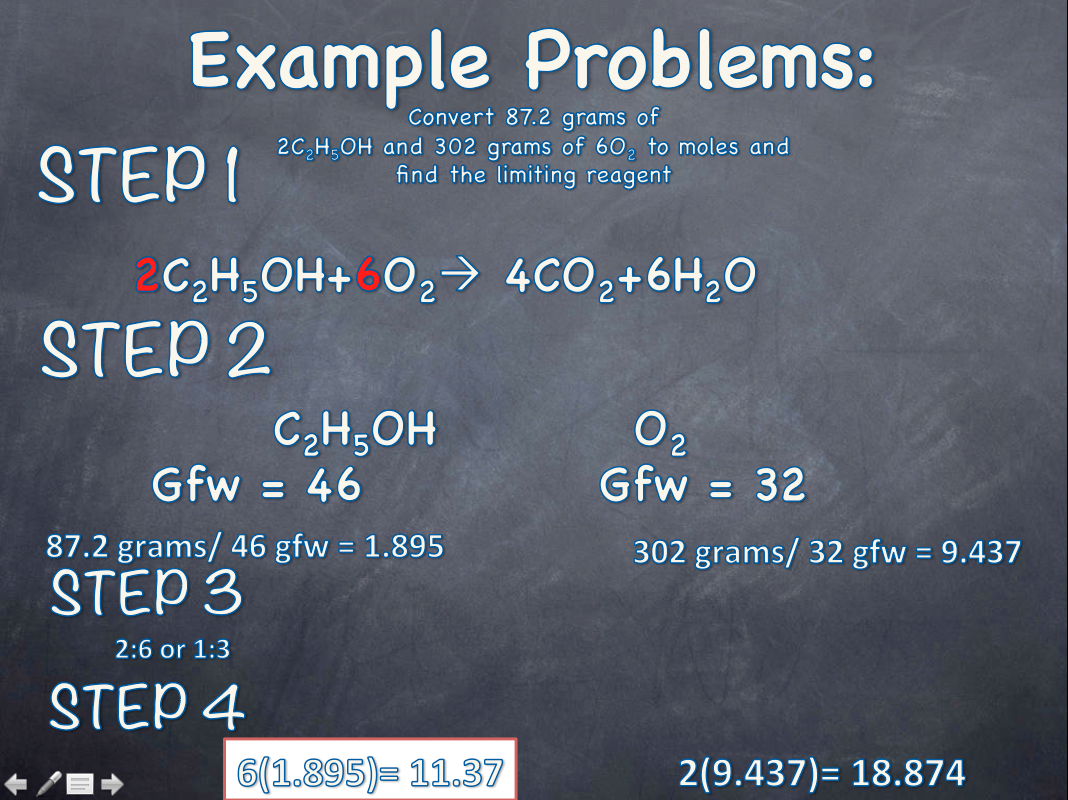
Oxygen is the limiting reactant.

How to find limiting reagent. Using the limiting reagent calculate the mass of the product. 692 grams 28 grams per mole 25 moles 4 10 moles. Much more water is formed from 20 grams of H 2 than 96 grams of O 2.
One way of finding the limiting reagent is by calculating the amount of product that can be formed by each reactant. The limiting reagent will be highlighted. Based on the coefficients of the reactants the two compounds find the ratio.
This allows you to see which reactant runs out first. Ammonia NH 3 is produced when nitrogen gas N 2 is combined with hydrogen gas H 2 by the reaction. We do this by looking at the atomic number of each element in the compound.
The ratio for this equation is going to be 12 magnesium Mg. To calculate the limiting reagent enter an equation of a chemical reaction the reactants and products along with their coefficients will appear. After 108 grams of H 2 O forms the reaction stops.
Grams H 2 O 108 grams O 2 O. You have enough ClCH2CH2CH2Cl to make 10 mol of ICH2CH2CH2I but you can only make 6 mol of this product with the NaI that you started with because you use two NaI molecules on every ClCH2CH2CH2Cl. Using the mole ration.
Therefore NaI runs out first and it is the limiting reagent. Using the product approach. One method is to find and compare the mole ratio of the reactants that are used in the reaction.
Introduction The following scenario illustrates the significance of limiting reagents. The one that produces less product is the limiting reagent. For the balanced equation shown below what would be the limiting reagent if 692 grams of N2 were reacted with 344 grams of H2O.
It explains how to identify the limiting reactant given the mass in grams. The answer is that NaI is limiting. The first step is calculating the molar mass of each chemical compound.
To find the limiting reactant you simply need to perform a mass-to-mass gram-to-gram calculation from one reactant to the other. Next to determine the limiting reagent we calculate the amount of reactant B required to completely react with all of reactant A. The reactant that produces the least amount of product is the limiting reactant.
Determine the limiting reagent if 100 g of ammonia and 100 g of oxygen are present at the beginning of the reaction. The reactants and products along with their coefficients will appear above. 50 grams of nitrogen gas and 10 grams of hydrogen gas are reacted together to form ammonia.
C2H5NSCl is the limiting reagent. There are a few steps that are necessary to find the limiting reagent. Enter any known value for each reactant.
The reactant that restricts the amount of product obtained is called the limiting reactant. We have to determine if one of the reactants is limiting and therefore the amount of CO 2 formed is based on the limiting reagent. Mg 2HCl -- MgCl2 H2 Step One.
There are two ways for how to calculate limiting reagent. In order to calculate the mass of the product first write the balanced equation and find out which reagent is in excess. This chemistry video tutorial provides a basic introduction of limiting reactants.
To find the limiting reagent take the moles of each substance and divide it by its coefficient in the balanced equation. One thing keep in mind is that the overall chemical reaction is control by limiting reagent Once chemical reagent is finish the reaction automatically stop because as soon the limiting. Find the Limiting Reactant Example.
The limiting reactant or reagent can be determined by two methods. Youre going to need that technique so remember it. Code to add this calci to your website Limiting Reactants.
To determine the amount of excess H 2 remaining calculate how much H 2 is needed to produce 108 grams of H 2 O. Another method is to calculate the grams of products produced from the quantities of reactants in which the reactant which produces the smallest amount of product is the limiting reagent. By the way did you notice that I bolded the technique to find the limiting reagent.
And the other one will called excess reagent. 1 For the balanced equation below what is the limiting reagent of 48g of Mg when it is reacted with 110g of HCl. N 2 3 H 2 2 NH 3.
The reagent which give lower number of moles after the division by coefficient will called as limiting reagent. The substance that has the smallest answer is the limiting reagent. To calculate the limiting reagent enter an equation of a chemical reaction and press the Start button.