Living and working between 1864 and 1920 Weber is remembered as a prolific social theorist who focused on economics culture religion politics and the interplay among them. The Sociology of religion by Weber is a piece with all his sociology.
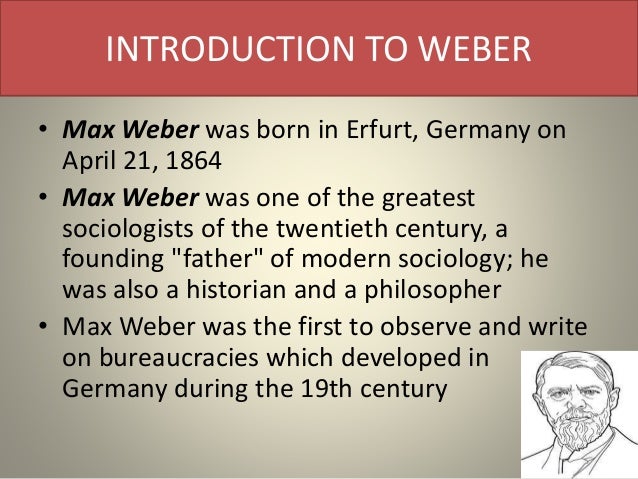 Presentation1 Contribution Of Max Webber
W eber is credited with numerous contributions to modern sociology and is considered one of the pillars of the discipline along with Karl Marx and Emile Durkheim.
:max_bytes(150000):strip_icc()/Mannheim_2017_003-28bbdb26db704c3d8fa31c0fbd014600.jpg)
Max weber contribution to sociology. Even though his life was brief he has had a long and prosperous impact. It is also his initial foray into the study of the role and importance of education. Given how much he wrote the variety of translations of his works and the amount written by others about Weber and his theories.
Despite being recognized as one of the fathers of sociology along. The law of causality applies to social events as to physical order of things and once we. The most important of these is that Weber himself was involved in a project very similar to that of the economic sociology of law.
Webers profound influence on sociological theory stems from his demand. Maximilian Karl Emil Weber ˈ v eɪ b ər. Webers definition is found on his book The theory of social and economic organization.
In 1896 he became professor of economics. Three of his biggest contributions to sociology include the way he theorized the relationship between culture and economy his theory of authority and his concept of the iron cage of. Max Weber was an important proponent of methodological antipositivism.
In the beginning he studied law. His ideas would profoundly influence social theory and social research. There are several reasons for singling out Max Weber in this respect.
A Critical Appreciation S. One of Webers most recognized contributions to sociology is his work on sociology in religion. DuBois and Harriet Martineau one of the founders of sociology.
Marx 1818-1883 was an established predecessor from Germany whose study of the nineteenth-century European society was widely acknowledged and Durkheim 1858-1917. In his lifetime Weber penned numerous essays and books. The Protestant Ethic is a major indeed the most significant contribution by Weber to sociology.
Firstly he argued that Verstehen or empathatic. Later he shifted to the study of social sciences. Srinivasa Rao1 Smriti Singh2 Karl Emil Maximilian Weber 18641920 more widely known as Max.
For the purposes of A level Sociology we can reduce Webers extensive contribution to Sociology to three things. Karl Emil Maximilian Weber 1864-1920 more widely known as Max Weber is credited with numerous contributions to modern sociology and is considered one of the pillars of the discipline along with Karl Marx and Emile Durkheim. One of the preeminent intellectuals of sociology Karl Emil Maximilian Weber died at the age of 56.
Max Weber is credited as one of the three founders of sociology but his most well-known contribution was his thesis that combined economic and religious sociology. Max Weber 1864-1920 was one of the founding fathers of Sociology. Max Weber born April 21 1864 Erfurt Prussia Germanydied June 14 1920 Munich Germany German sociologist and political economist best known for his thesis of the Protestant ethic relating Protestantism to capitalism and for his ideas on bureaucracy.
Webers main concerned was to what extent religious conception of the world of existence have influenced the economic behaviour of various societies and specially the western society. Max Weber was born in 1864 in Germany. This thesis proposed that ascetic Protestantism was associated with the rise of Western market-driven capitalism.
Although he does not place any special thrust on education in his discussion of Calvinism ethics and the capitalist turn he does refer to the ideas of the educated in all of these topics. He was said to be an influencer and his ideas caused many social theories and social research. Max Webers Contribution to the Sociology of Education.
His study promulgates that how far a particular sect of religion can influence the economic behaviour of its followers. Some writers close to religious sociology have come to call Weber aChristian sociologist. What is Max Webers contribution to sociology.
DuBois and Harriet Martineau Max Weber is considered one of the founders of sociology. His studies in the field led to the publication of his work Sociology of religion. Weber saw both structural and action approaches as necessary to developing a full understanding of society and social change.
The main purpose of this article is to provide an introduction to the contribution of Max Weber to the economic sociology of law. Max Weber has defined sociology in his own way. Thesis was on the History of Commercial Societies in the Middle Ages.
He tried to develop a scientific method for the development of sociological studies. 21 April 1864 14 June 1920 was a German sociologist historian jurist and political economist who is regarded among the most important theorists on the development of modern Western society. Weber Contribution to Sociology.
With Karl Marx Emile Durkheim WEB. Max Weber Ideal Type. With these contributions he is considered along with Karl Marx Emile Durkheim WEB.
Weber wrote a lot of essays and books throughout his career. Max Weber Ideal Type. He is also known a Max Weber.
Webers Contribution to Sociology. According to Weber social laws could be generalized in the same way as the physical laws. He defined sociology as sociology is the science which attempts to explain social action in order to arrive at the causal explanation of its results.
Contribution of Max Weber and Karl Marx towards Sociology. A German sociologist philosopher political economist and Jurist Maximilian Karl Emil Max Weber came in this world on 21 st of April 1864 and took his last breath on 14 th of June 1920.
It is therefore a macro-level analysis of society. Conflict theory sees social life as a competition and focuses on the distribution of resources power and inequality.
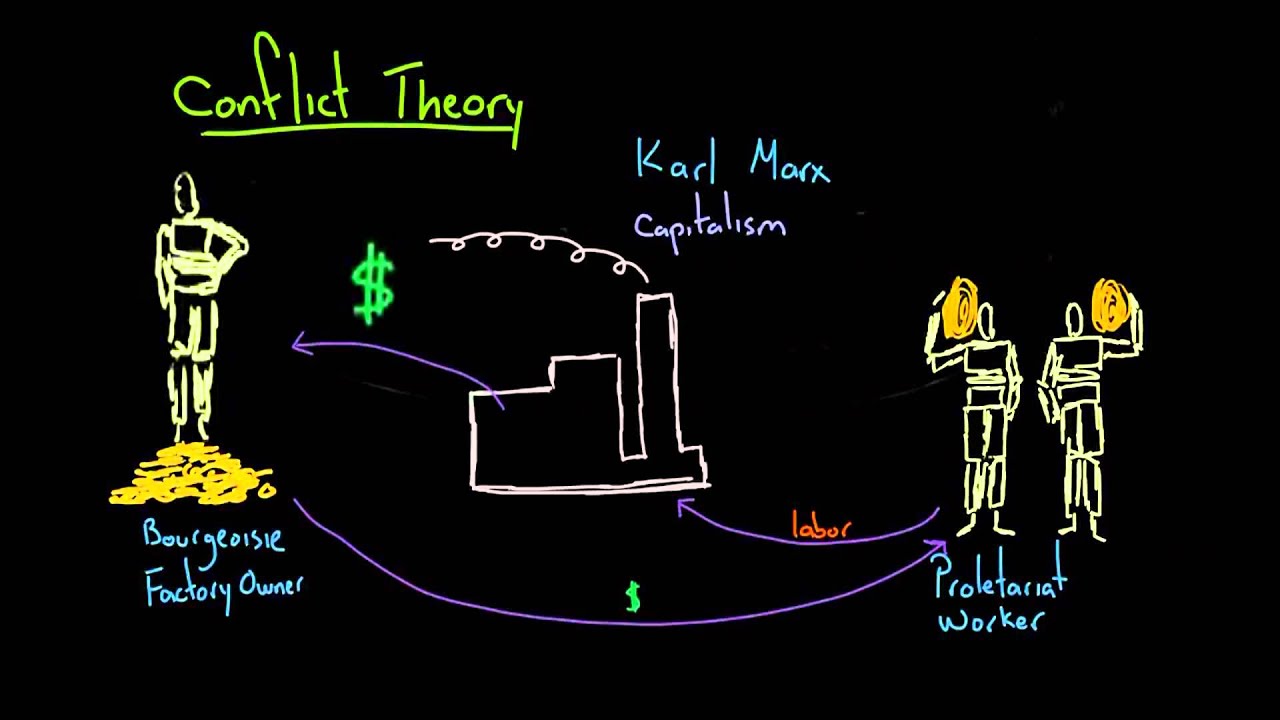 Conflict Theory Youtube
Examples of social conflict theory can be found in a variety of situations.
Conflict theory definition sociology. Initially the term seemed merely to identify a more politically neutral Marxian perspective but for some it meant something much broader. Its a way of viewing and studying people that. Today however the term conflict theory is more often used to refer to the sociological writings of opponents to the dominance of structural functionalism in the two decades after the Second World War.
Through various forms of conflict groups will tend to attain differing amounts of material and non-material resources eg. Social conflict theory is a Marxist -based social theory which argues that individuals and groups social classes within society interact on the basis of conflict rather than consensus. Conflict theory is a sociological theory associated with Karl Marx.
These perspectives run contrary to structural functionalism which defines society by its level of cooperation. Two classic sociological approaches to poverty and social stratification are structural-functionalism and conflict theory. Conflict theories are pespectives in sociology that emphasize the social political or material inequality of a social group that critique the broad socio-political system or that otherwise detract from structural functionalism and ideological conservativism.
Conflict theory originated with the work of Karl Marx in the mid-1800s. The term conflict theory crystallized in the 1950s as sociologists like Lewis Coser and Ralf Dahrendorf criticized the then dominant structural functionalism in sociology for overly emphasizing the consensual conflict-free nature of societies see Classics of the Conflict Theory Paradigm. Conflict theories draw attention to power differentials such as class conflict and generally contrast historically dominant ideologies.
The term conflict theory came into wide use in sociology during the 1960s when it was seen as an alternative to and rival of functionalism. Definition of Social Conflict Social conflict theory is a macro-oriented paradigm in sociology that views society as an arena of inequality that generates conflict and social change. This perspective is a macro-level approach most identified with the writings of German philosopher and sociologist Karl Marx 18181883 who saw society as being made up of two classes the bourgeoisie capitalist and the.
A sociological theory of poverty that argues that stratification is dysfunctional and harmful to society but persists because it benefits the rich and powerful. Conflict theory refers to a group of perspectives within sociology that explain society in terms of the discordance between social groups. Conflict theory suggests that human behavior in social contexts results from conflicts between competing groups.
KARL MARX ON CONFLICT THEORY Conflict theory in short was the theory which showed everybody how the difference in rights and power in different groups can lead to conflicts and tension among the various groups of people. The power and rights worked as the key factors in determining a persons position in society. It is one of the four paradigms of sociology which include functionalism symbolic interactionism and feminism.
Conflict theories are perspectives in sociology and social psychology that emphasize a materialist interpretation of history dialectical method of analysis a critical stance toward existing social arrangements and political program of revolution or at least reform. Conflict theory looks at society as a competition for limited resources. Noun A theory that emphasizes the role of coercion conflict and power in society and that social inequality will inevitably occur because of differing interests and values between groups particularly the competition for scarce resources.
Unlike functionalist theory conflict theory is better at explaining social change and weaker at explaining social stability. Karl Marx is regarded as the father of s. Definition of Conflict Theory.
It seeks to explain political and economic events in terms of an ongoing struggle over finite resources. Conflict theory states that tensions and conflicts arise when resources status and power are unevenly distributed between groups in society and that these conflicts become the engine for social change. Conflict theory in sociology describes societys tendency to change and develop due to perpetual conflict between classes.
The race-conflict approach is a sociological perspective that looks at disparity and tension between people of different racial and ethnic groups.