Spectator ions are the species in a chemical reaction that arent involved in the reaction. Any dissolved ions that appear in the same form on both sides are spectator ions.
 Precipitation Reaction Spectator Ions Example Youtube
They are present in total ionic equations to balance the charges of the ions.

How to identify spectator ions. In this case the hydroxide OH 1 and hydride H ions from the LiOH and H Br respectively remain in solution. They simply watch the other ions react hence the name. These ions just spectate watch while the other ions form the copper chloride.
If you consider their possible combination into water they might not be considered spectators. If the presence of. To do this you want to make sure that you have the ah you identify the acquiesced ionic compounds and then you can subsequently find out our ah separated into its individual ions it with science.
EG KBr aq AgNO3 aq ---- KNO3 aq Introduction to General Organic and Biochemistry 10th Edition Edit edition. They remain in solution as ions. To determine the spectator ions in a reaction the compounds that make up the reaction must be broken down into ions if possible.
Removing the spectator ions yields the net ionic equation. Express each of the reactants and products in terms of its cations and anions. Since both of the reactants are soluble in water before a reaction occurs sodium chloride silver and nitrate ions are in solution.
Identify the spectator ions in the following complete ionic equation. Do not enter the coefficient. 4 ions are spectator ions since they remain unchanged on both sides of the equation.
H aq OH- aq - H2O l Again the spectator ions are the ions present on both sides of the complete ionic equation and are not included in the net ionic equation. In some chemical reactions there are cases where some ions in the solution do not take part in the process. Only ionic compounds can be broken down in this way not molecules whose atoms are bonded together.
In a redox reaction a spectator ion is an ion whose oxidation number does not change in the course of the reaction. Any ions that are aqueous on both the left and right sides of the equation are spectator ions. The spectator ion in the reaction is eqNO_3- eq Spectator ions appear on both sides of the reaction.
Spectator ions are simply those ions in a reaction solution that do not themselves react. 2 Al 3 CuCl 2 2 AlCl 3 3 Cu. For example consider the redox reaction.
When two ions in a reaction form a gas water or an insoluble compound they are not spectator ions. The fourth step is to identify the spectator ions. Now we see that Na and Cl- are present on both sides of the equation and so those are our spectator ions.
Lets take a closer look at the reaction between sodium chloride and silver nitrate. Split them up into individual ions. If all reactants and products cross out then no reaction will occur.
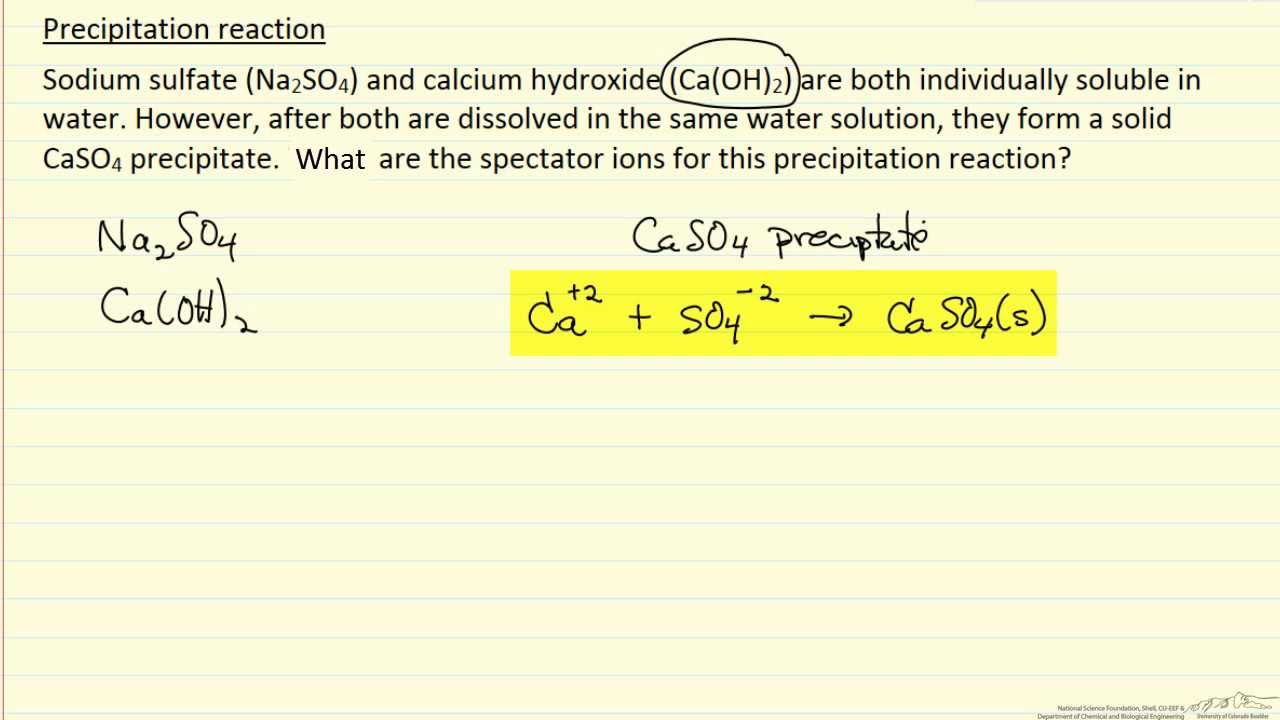
Compare the reactant and product sides of the rewritten reaction and cross out the spectator ions. The sodium ions and sulfate ion are the spectator ions in this reaction. And then this third step is to write the total Ionic equation in order to do just in order.
EG KBr aq AgNO3 aq ---- KNO3 aq AgBr s Here NO3 is a. Cross out the spectator ions to produce a net reaction. In this reaction the chloride ion is a spectator ion since its oxidation number doesnt change.
How to Identify and List the Spectator Ions in a Reaction Step I. Whereas the Cu 2 and CO 2 3 ions combine to form a precipitate of solid CuCO 3. A spectator ion refers to a charged atom in a chemical reaction that does not undergo a chemical change.
Anything that doesnt change its compound ORAND state aq s lg is a spectator ion. Learn this topic by watching Complete Ionic Equations Concept Videos. Since eqNO_3- eq appears in the reactants and in the products it is the spectator ion.
Check out a sample QA here. Ba 2 aq 2 I -aq 2 Na aq SO 4 2-aq BaSO 4 s 2 I -aq 2 Na aq Express your answers as ions separated by a comma. Write the equation with chemical formulas for which spectator ions are to be determined.
They appear unchanged in both the product and reactant side of the equation.