Click to see full answer. In this regard the boiling point of water changes with a change in barometric pressure.
 What Is The Boiling Point Of Water Quora
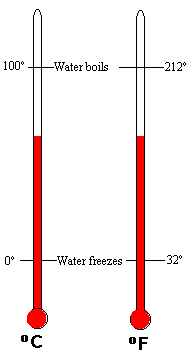
The Fahrenheit scale defines the freezing point of water as 32F and the boiling point as 212F.
Boiling point of water in fahrenheit. The Fahrenheit scale is now usually defined by two fixed points. 762 m 207 oF. 3000 ft 914 m 206 oF.
Fahrenheit definition is - relating or conforming to a thermometric scale on which under standard atmospheric pressure the boiling point of water is at 212 degrees above the zero of the scale the freezing point is at 32 degrees above zero and the zero point approximates the temperature produced by mixing equal quantities by weight of snow and common salt abbreviation F. Water with 20 percent salt boils at 216 degrees Fahrenheit as opposed to 212 degrees Fahrenheit for pure water. At sea level water boils at 100 C 212 F.
It is always the same - 100C or 212F. 1000 ft 305 m 210 oF. The normal boiling point is the temperature at which the vapour pressure is equal to the standard sea-level atmospheric pressure 760 mm 2992 inches of mercury.
Temperature given as C F K and R. When measuring temperature the usual units are Celsius degree Celsius or Fahrenheit degree Fahrenheit. Boiling Point - Fahrenheit.
The Celsius scale sets the freezing point and boiling point of water at 0C and 100C respectively. Fahrenheit is a temperature scale that bases the boiling point of water at 212 and the freezing point at 32. The boiling point of salt water depends on the percentage of salt.
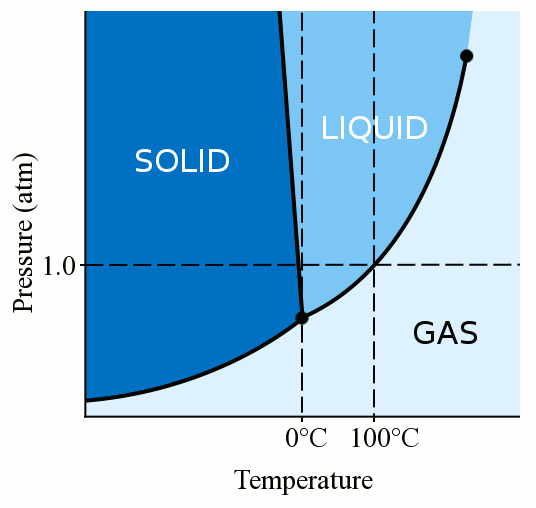
The boiling point of water depends on the atmospheric pressure which changes according to elevation. The normal boiling point is 9997 C 2119 F at a pressure of 1 atm ie 101325 kPa. Similarly the freezing point of water at sea level is a constant value - 0C or 32F.
Actually the formula for boiling point uses this value as the basis of calculations. Two points define the contemporary Fahrenheit scale the freezing point of water which is set out as 32 F and the boiling point of water which is set at 212 F. Over time this replaced body temp as the upper landmark on his scale.
See Water and Heavy Water for thermodynamic properties at standard condtions. You dont have to use our boiling point at altitude calculator to determine the boiling point of water at sea level. What is the boiling and freezing point of water in Celsius.
The boiling point of a liquid varies according to the applied pressure. The difference between the freezing and boiling points of water is 180 degrees apart unlike in the Celsius scale where the two points are 100 degrees apart. 152 m 211 oF.
1067 m 2055 oF. At some point Fahrenheit figured out that the boiling point of water came in at 212 degrees. It was developed by Daniel Gabriel Fahrenheit a German-born scientist who lived and.
Water boils at 3732 K Kelvin 100oC Celsius or 212oF Fahrenheit. Pressure must be within the ranges 1-220 bara 147-3200 psia 760-165 000 mm Hg or 30-6500 in Hg. There are two conventions regarding the standard boiling point of water.
However when reporting temperatures in Kelvin we dont say degree Kelvin. The temperature at which pure water freezes into ice is defined as 32 F and the boiling point of water is defined to be 212 F both at sea level and under standard atmospheric pressure a 180 F separation. The simple answer to this question is that the boiling point of water is 100 C or 212 F at 1 atmosphere of pressure.
Meanwhile as more precise measurements were made body temperature had to be adjusted to 986 degrees. However the value is not a constant. Boiling water is characterized by energetic bubbles and steam and it is considered to be hot.
457 m 209 oF. 1219 m 204 oF. 610 m 208 oF.
Water Boiling Points at Higher Pressure - Online calculator figures and tables showing boiling points of water at pressures ranging from 147 to 3200 psia 1 to 220 bara. Adding a small amount of salt to a pot of boiling water does not make it boil significantly faster. Boiling Point - Celsius.
0 m 212 oF. The IUPAC recommended standard boiling point of water at a standard pressure of 100 kPa 1 bar is 9961 C 2113 F. Conventionally the temperature at which water boils is 100 degrees Celsius or 212 Fahrenheit but only at sea level.
Boiling points of water at absolute pressures ranging from 1 to 70 bara or 147 to 1000 psia are indicated in the figures and tables below.
The freezing point of water is affected by the purity of the water and to a lesser degree atmospheric pressure. The temperature of freezing of water in the seas and oceans does not have a constant value since the salinity of the water in different seas of the oceans is completely different.
 Can Water Stay Liquid Below Zero Degrees Celsius Science Questions With Surprising Answers
Temperature scale in which zero occurs at absolute zero and each degree equals one kelvin.

At what temperature does water freeze. However you definitely need to start to worry once the temperature gets below the freezing temperature of 32 degrees Fahrenheit or 0 degrees Celsius. At this point there is a risk that your pipes could freeze. Due to the high salt concentration ocean and sea water freezes at a temperature of -19 degrees Celsius.
As we mentioned above there isnt a definitive temperature where your RV water lines will freeze. Water that is a saturated salt solution which has as much salt as the water can hold freezes at minus 6 degrees Fahrenheit. Scientists have found liquid water as cold as -40 degrees F.
Water freezes at 32 degrees Fahrenheit but indoor pipes are somewhat protected from outdoor temperature extremes even in unheated areas of the house like in the attic or garage. Water freezes at a temperature of 32 degrees Fahrenheit 0 degrees Celsius and 273 degrees Kelvinat sea level. Thats not always the case though.
Some of you may also know that the Celsius scale was initially set with zero being defined as the point that water freezes and we casually say that the temperature is below freezing when it is less than zero. At What Temperature Does It Freeze. She like everyone else was taught in one of her very earliest science lessons that ice is frozen water and that water freezes at zero Celsius.
As a general rule temperatures outside must drop to at least 20 degrees or lower to cause pipes to freeze. Water freezes at 27315 K and boils at 37315 K. The freezing point of water is 32-degrees Fahrenheit and the water in your pipes holds no exceptions.
If you want to know what water freeze temperature is. The addition of any impurities such as salt or ethylene glycol anti-freeze will lower the freezing point. The salt content of the ice is almost non-existent making it drinkable once melted.
In general water solidifies at 0 o C but the time will differ based on the factors discussed above. The freezing point is the temperature at which a liquid becomes a solid according to About. The temperature of an unheated portion of a house is almost.
Ordinarily the freezing point of water and melting point is 0 C or 32 F. Click to see full answer. Contrary to popular perception pure liquid water does not usually freeze at its melting point 0C and can instead supercool to temperatures as low as -38C.
For ice formation to occur at relatively warm temperatures above -20C a heterogeneous substance a solid particle called a nucleator is required to trigger the initial nucleation event that must precede growth of ice crystals. The temperature may be lower if supercooling occurs or if there are impurities present in the water which could cause freezing point depression to occur. As the temperatures drop you might be worried about the water flowing through your pipes.
We know that water freezes at 32 degrees Fahrenheit But the problem here is that theres a temperature difference between the outside environment and our homes as room temperature differs most of the time. Water freezes at zero degrees Celsius under normal conditions. Although 20 degrees Fahrenheit is well below the freezing temperature of water two factors make this the critical outdoor temperature.
Fresh water freezes at 32 degrees Fahrenheit. Freezing point temperature of pure water is 0 Celsius at atmospheric pressure. Pure water freezes at 32 degrees Fahrenheit which is zero degrees Celsius.
The melting point of water at 1 atmosphere of pressure is very close to 0C 32F 27315 K and in the presence of nucleating substances the freezing point of water is close to the melting point but in the absence of nucleators water can supercool to 40C 40F 233 K before freezing. Weve all been taught that water freezes at 32 degrees Fahrenheit 0 degrees Celsius 27315 Kelvin. Any water that remains in the pipes has the ability to freeze and give you problems.
But as the freezing point curve of pure water has negative slope so at pressure values below atmospheric pressure and above triple point pressure water can freeze at temperature values slightly above 0 Celsius. Temperature scale that registers the freezing point of water as 0 degrees C and the boiling point as 100 degrees C under normal atmospheric pressure.
It is a homogeneous mixture and a heterogeneous one. Your email address will not be published.
 Homogeneous Mixture Experiment Qs Study
Air with clouds is heterogeneous as the clouds contain tiny droplets of liquid water.

Is water heterogeneous or homogeneous. Vinegar and oil salad dressing is heterogeneous since two liquid layers are present as well as solids. Suppose we mix up salt and sugar in their solid form. To be more precise generally almost 90 of the time salt water is a homogeneous mixture.
Uncategorised By No Comments 1 Viewers. A suspension is a heterogeneous mixture consisting of solid particles that may remain suspended momentarily or dispensed throughout the liquid phase by mechanical agitation or shaking. Mixtures can be either homogeneous or heterogeneous.
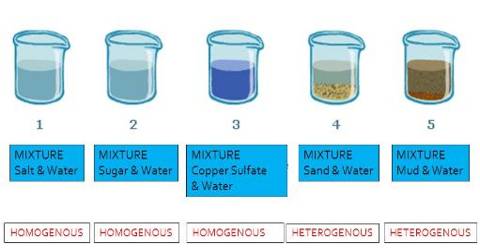
A mixture in which constituents are distributed uniformly is called homogeneous such as salt in water otherwise it is called heterogeneous such as sand in water. Homogeneous mixture is a mixture that is made up of one phase only such as salt dissolved in water. A mixture of water and salt is an example.
Then we have a heterogeneous mixture because it is almost impossible to have a perfectly uniform mixture of the two. Lemon juice is a homogeneous mixture while gravel and sand in a concrete mixture is heterogeneous. In a homogeneous mixture the concentration is the same at every place.
Both are mixtures but only the sugar-water can also be called a solution. Also get various engaging and interactive video lessons to learn more effectively. When oil is mixed with water the separation of two layers is visible to the eye.
SOLUTIONS are homogeneous mixtures. Water is a homogeneous mixture of nitrogen oxygen and smaller amounts of other compounds in the gaseous materials. A homogeneous mixture is a mixture in which the composition is uniform throughout the mixture.
So you can say that tap water is uniform in composition throughout. Is water a heterogeneous mixture. So you wouldnt observe both a liquid and a gas or a liquid and a solid in a homogeneous mixture.
Whereas in the heterogeneous mixture the frequency varies from various factors. Often it is easy to confuse a homogeneous mixture with a pure substance because they are both uniform. Oil and water is a fine example of a heterogeneous mixture.
Mixtures can be characterized by being separable by mechanical means eg. Salt water is made by mixing salt NaCl in water. Also is sugar solution a mixture Why.
Heat filtration gravitational sorting centrifugation etc. Here are 10 examples of heterogeneous mixtures. The sugar-water is a homogenous mixture while the sand-water is a heterogeneous mixture.
Stay tuned with BYJUS to learn more interesting topics in Chemistry. A homogeneous mixture is a mixture in which the components that make up the mixture are uniformly distributed throughout the mixture. The salt water described above is homogeneous because the dissolved salt is evenly distributed throughout the entire salt water sample.
A difference between the two is that concentration is same everywhere in case of a. 23 Dec is water a compound or homogeneous mixture. The terms homogeneous and heterogeneous are not usually used to describe pure substances.
Homogeneous mixture- its a mixture of. Water is a pure chemical compound dihydrogen monoxide H2O. Mixtures are of two types.
The composition of the mixture is the same throughout. Nope tap water is a homogeneous mixture not heterogeneous. It contains only water molecules.
You cannot differentiate salt from water since they are seen by the naked eye as a single. Oil and water form a heterogeneous mixture. A sugar solution is homogeneous since only a colorless liquid is observed.
Cereal in milk is a great example of a heterogeneous mixture. This is because tap water has dissolved minerals inside it but they are equally distributed throughout the water. Sandy water is a heterogeneous mixture.
A pepperoni pizza is a heterogeneous mixture. There is only one phase of matter observed in a homogeneous mixture at a time. Let us study how these mixtures differ from each other.
There are mainly two types of mixtures homogeneous and heterogeneous mixtures. A solution of sugar or salt in water is homogeneous mixture. ----- Actually natural water is heterogeneous as it is a mixture of H2O and a very tiny amount of D2O.
Orange juice with pulp is a heterogeneous mixture. Homogeneous and heterogeneous mixture. Unlike homogeneous mixtures heterogeneous mixtures do not have the same composition throughout.
There is no change in energy during the making of the mixture. Pure Water is a pure substance.
A drop of water is 005 mL of water so its mass would be 005 grams. 1007942 159994 Percent composition by element.
/GettyImages-692027135-419fe3ddc26e4415b356380582c4e5b2.jpg) How Much Water Is A Mole Of Water
How Much Water Is A Mole Of Water
How many moles of water is this.
One mole of water. Hence the volume should be. One mole of water at 100C is converted into steam at a constant pressure of 1 atm. The molar mass of water is 18 10 3 k g m o l 1 and the density is 1 10 3 k g m 3.
The applicant is also required to present a sample of writing to the Evaluation Department. Fortunately this is another simple calculation. For example the average mass of one molecule of water is about 180153 daltons and one mole of water N molecules is about 180153 grams.
However each water molecule contains 2 hydrogen atoms and one oxygen atom. All applicants go through a series of tests that check their level of English and knowledge of formatting styles. C 1 mole of ionic substances contains 602 10 23 formula units.
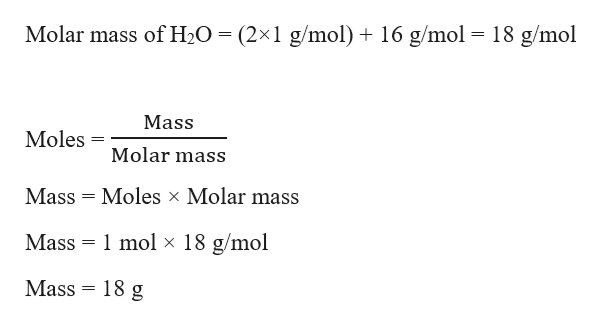
From the periodic table we see the atomic weight of hydrogen is 10079 and the atomic weight of oxygen is 159994. One mole of water is 18016 grams so in 005 grams in one drop the number of moles is. Moles of water in one drop 005 grams x 1 mole18016 grams.
Its easier to grasp how much water is in a mole if you find the volume of this amount of mass. Thus for example one mole of water contains 6022 140 76 10 23 molecules whose total mass is about 18015 grams and the mean mass of one molecule of water is about 18015 daltons. Therefore one mole of H 2 O contains 2 moles of hydrogen and one mole of oxygen.
Solution for The evaporation of one mole of water at 298 K has a standard free energy change of 858 kJH2Ol H2Og DG298 858 kJa Is. One mole of liquid water is in a closed vessel whose temperature is 273 K whose initial internal pressure is 1 atm and whose interior volume is 50 times the volume of the water. The change in entropy is heat of vaporisation of water at 100C 540 calgm.
Water molecular weight. Related Quantities and their Formulae. A mug of water was measured to contain 205 grams of water.
For example a mole of water contains N A number of H 2 O molecules. Unless you have a good sense of mass this value probably doesnt have much meaning to you. Weight of water 180152 g.
Check out a sample QA here. Therefore one mole of water weighs 180152 grams. The mole is widely used in chemistry as a convenient way to express amounts of reactants and products of chemical reactions.
Since water is H2O one molecule has 3 atoms 2 of hydrogen1 of oxygenSo total atoms 360231023 180691023 atoms 37K views View 4 Upvoters. What is the mass of one mole of water h2o check_circle Expert Answer. One mole of water contains Avogadros number of molecules ie 6023 1023 water molecules.
Convert grams Water to moles or moles Water to grams. Want to see the step-by-step answer. A mole of water molecules would be 2 moles of hydrogen atoms plus 1 mole of oxygen atoms.
In other words 1 milliliter of water has a mass of 1 gram. Solution for One mole of water is equivalent to 18 grams of water. Mass of 1 Mole of Water Water H2O is made from 2 atoms of hydrogen and 1 atom of oxygen.
For example 1 mole of water contains 602 10 23 H 2 O molecules. For example 1 mole of sodium oxide contains 602 10 23 formula units of Na 2 O. If we have one mole of water then we know that it will have a mass of 2 grams for 2 moles of H atoms 16 grams for one mole O atom 18 grams.
Since we only have 0001 grams that means that we have NA 000118 3351019 molecules of water. V 1 m o l 18 10 3 k g m o l 1 1 10 3 k g m 3 18 10 5 m 3. Chemistry QA Library What is the mass of one mole of water h2o What is the mass of one mole of water h2o Question.
Molar mass of H2O 1801528 gmol.
If the ice were to sink as it froze entire lakes would freeze solid. Water has some unique thermal properties.
 Why Water Is More Dense Than Ice
For most substances density increases as temperature decreases.

Is ice denser than water. No water and ice do not weigh the same. Any ice that forms will float to the surface and be melted by the sun. But when we are talking about water something else happens.
However peak density of water occurs in water at around 4 o C and decreases at temperatures both above and below this see Figure 1. This process would continue until there were only a relatively thin layer of water in the more temperate zones. Because ice is less dense than the underlying water it floats.
You touched on the answer to why when you ask if ice would sink. Water is denser than ice. As ice displaces the heavy weight water it floats on the top of water.
The regular arrangement of oxygen atoms will give a lattice structure to the water known as ice. Ponds or lakes begin to freeze at the surface closer to the cold air. That is something you can weigh.
Thus the liquid form of water although engaged in transient hydrogen bonding is not as open and expanded as when held into its solid form by the rigid semi. The reason behind water having a more substantial volume than ice is that water occupies less space than ice. Ice is less dense than water and the pro.
Humm well lets first understand that a ton of water weighs the same as a ton of ice and the same as a ton of cotton. In other words ice takes up about 9 more space than water so a liter of ice weighs less than liter water. That is anomaly of water.
The density of ice is 09167 09168 gcm 3 at 0 C and standard atmospheric pressure 101325 Pa whereas water has a density of 09998 0999863 gcm 3 at the same temperature and pressure. When water is kept under different states like solid water and gas the volume varies as per the density and weight of the water. NO ice is not heavier than water.
The anomalous properties of water are those where the behavior of liquid water is quite different from what is found with other liquids. For example if we take the same volume of water and ice in the same container water would weigh more than ice. What you might be asking is why is ice DENSER than water.
The additional space created reduces the density of the water as it freezes making ice less dense than water. Water is unusual in that its maximum density occurs as a liquid rather than as a solid. Ice is less dense than liquid water and so it floats.
Ice floats because it is about 9 less dense than liquid water. The density of water is 1gmL. Hydrogen bonding make ice less dense than liquid water.
If you weigh the same volume of water and ice in a container then you will notice that the volume of water weighs more than that of ice. The density of ice is 09 gram per centimetre cube. This means ice floats on water.
The density of ice is 06gmL. It is found that ice occupies 9 percent more volume than water and hence it weighs lesser than water. If ice was denser than water life would not exist on this planet.
Solid water or ice is less dense than liquid waterIce is less dense than water because the orientation of hydrogen bonds causes molecules to push farther apart which lowers the density. When water freezes water molecules form a crystalline structure maintained by hydrogen bonding. Density of ice is lower than water.
The heavier water displaces the lighter ice so ice floats to the top. Because ice is less dense than water the deep oceans can never freeze even below zero degrees because to freeze they would have to expand and the pressure prevents this. The solid form of most substances is denser than the liquid phase thus a block of most solids will sink in the liquid.
Clearly once this crystaline structure is no longer forced into place by the rigid hydrogen bonding in ice it can collapse into itself resulting a greater density of water molecules. This is important because it allows ice to float above water. If the water cools below 4 degree C the hydrogen bonds are adjusted to bind with the oxygen atoms.
When water is frozen into ice the change in temperature creates excess hydrogen bonds between water molecules that increase the space between the molecules. Water has a different molecular dependency and forms. Well the truth is its not.
It insulates the water during cold seasons so that marine life will not have an over-cool environment hence allowing them to survive. This produces a crystal lattice commonly known as ice. As ice is less dense than water it floats.
The reason is that water is denser than ice and the space it occupies is less as compared to that occupied by ice. A layer of ice forms but does not sink as it would if water did not have this unique structure dictated by its shape polarity and hydrogen bonding. If ice were denser than water it would sink and the layer on top would freeze and sink.